
What Walker County Deed Records Document
Deeds recorded in Walker County track every transfer of an interest in land. A few related instruments appear besides. The Walker County Judge of Probate keeps the books. That duty belongs to Probate, not the Revenue Commissioner or the Circuit Clerk. A typical deed names the grantor and grantee. It describes the land, states the instrument type, and cites a book, page, or instrument number. The index also opens doors to mortgages, releases, easements, restrictions, plats, and corrective deeds. Those documents matter, but they serve different purposes than a conveyance.
| Deed Type | What It Does | Common Use |
|---|---|---|
| Warranty deed | Conveys the stated interest with title covenants written into the instrument | An arms-length sale or other full conveyance |
| Quitclaim deed | Conveys whatever interest the grantor holds without the same warranties | Family transfers, corrections, or clearing a possible interest |
| Executor, administrator, or trustee deed | Conveys through a fiduciary acting for an estate or trust | Estate administration or trust-owned land |
| Tax deed | Records a transfer arising from the statutory delinquent-tax process | Tax-sale research requiring the complete proceeding |
| Corrective deed | Corrects a stated defect in an earlier recorded instrument | Name, description, or reference corrections |
One distinction does a lot of work here. A deed transfers an interest in land; a mortgage, lien, restriction, or easement can shape or burden that interest without moving ownership at all. So never trust an index line by itself. Pull the related instruments, read the images, and then decide what the record actually says.
Inside the Walker ING Land Index
The Walker County Probate office site is the official starting point for land-record service in the county.
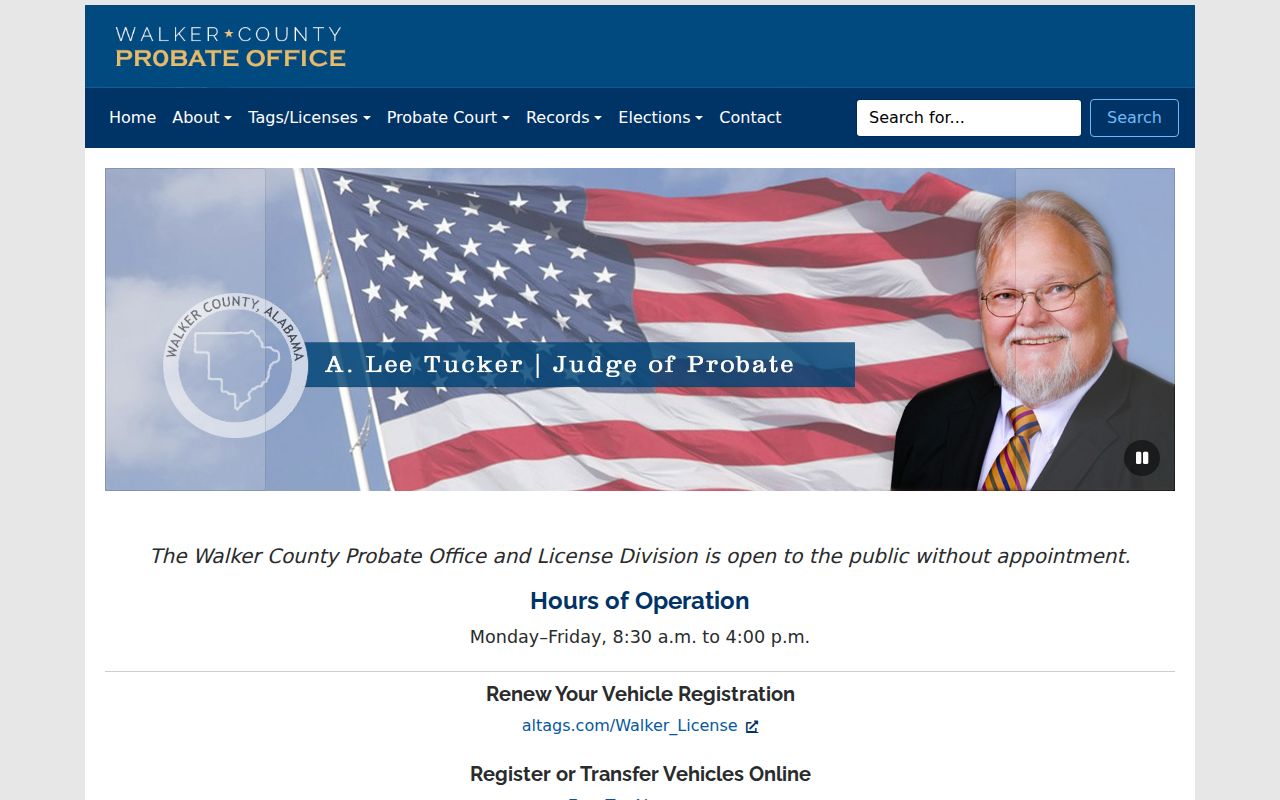
Walker County splits its land-record access into two pieces. The office landing identifies the public custodian. The ING interface handles remote searching and document delivery.
The county connects its online land-record service through the ING Walker portal. Land records and probate case records sit on separate search paths. The provider's public-search instructions lay out the controls. They also draw a clear line between a result list and a document view. Page purchases, a full-document cart, and cross-reference displays each behave differently. Knowing which screen you are on saves time.
| Search control | How it narrows a Walker deed search |
|---|---|
| Search Type | Chooses the indexed method used for the query. |
| Party role | Limits a name to Grantor, Grantee, Assignee, or all available roles. |
| Date range | Restricts recordings to the entered period. |
| Starts With | Controls whether the entered party text is treated as a prefix. |
| Instrument Type | Filters document families separately from Book Type. |
| Book / Page | Retrieves a known recording reference rather than searching broadly by name. |
The portal publishes no starting year for Walker County's online land records. A blank search result can mean several things. The deed you want may predate the digitized holdings. Or the name may be recorded under a variant spelling. Treat an empty result as unresolved. Confirm the date coverage and test alternate spellings first.
Open the Walker land-record entry screen first. Then pick the record path that matches your deed search.
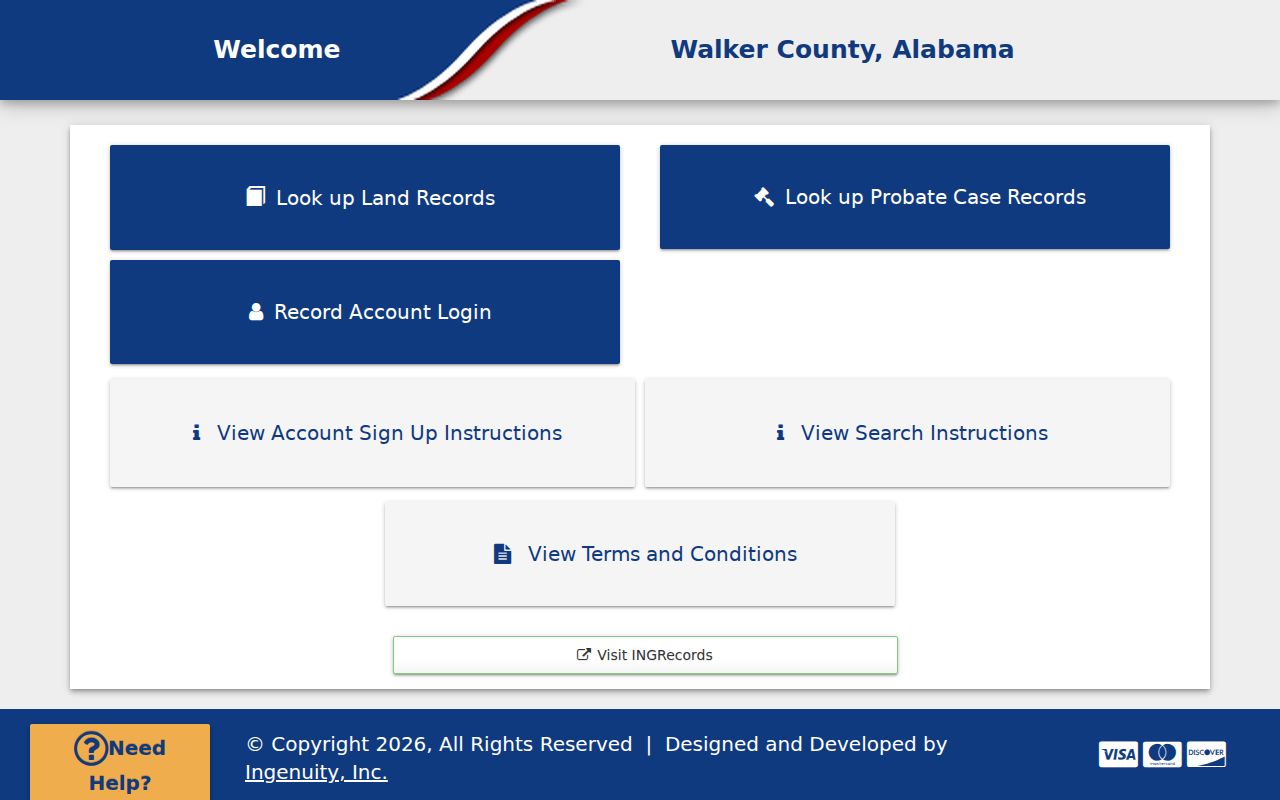
Reaching the entry screen settles nothing about the deed itself. Reading and certifying the underlying image is still a separate step.
Following Walker County's Grantor-Grantee Trail
Every chain starts with one known instrument and walks backward through the named parties and their prior references. A surname-only search is usually the smart first pass. Married names, initials, trusts, estates, punctuation habits, and entity suffixes all vary across decades of recording.
- Use the current parcel's deed book/page or owner name to locate the newest plausible deed, with that owner indexed as grantee.
- Open the image and compare its legal description with the parcel. Record the grantor, execution date, recording date, and prior-deed reference.
- Search that grantor as an earlier grantee, using date and instrument filters. Repeat only after the land description matches.
- If the trail predates verified online coverage, ask Probate for the reverse index and physical deed book rather than declaring the chain ended.
- Grantor
- The party transferring the interest.
- Grantee
- The party receiving the interest.
- Chain of title
- The linked sequence of conveyances affecting the same land.
- Book/Page and instrument number
- Recording references used to retrieve a specific filed document.
Note: A matching owner name proves little on its own, since the legal description is what anchors the chain to the right parcel.
Cross-References Reveal More Than a Sale
A cross-reference can matter more than a sale. ING's instructions describe a cross-reference control for records that carry one. It pays to follow whenever an assignment, correction, re-recording, satisfaction, or release points somewhere else. A mortgage result does not mean the debt is still unpaid. Match every release to the obligation it discharges. A court caption alone does not move title either. The signed order, plus any Probate recording that gives it effect against the land, is what carries weight. For each instrument worth keeping, log the details. Note the type, parties and their roles, execution and recording dates, book/page or instrument number, legal description, image status, and any forward or backward references. Precise labels help here. "Indexed," "image viewed," and "certified copy obtained" are three different claims. The discipline keeps a search result honest.
When Walker Deed Research Reaches 1950
Research that reaches 1950 crosses a custody line. The Alabama Secretary of State land collection holds state land records from statehood through 1950. It is searchable by name, township-range-section, and book. The agency sends everything after 1950 back to the county Probate Judge. That is where the records live. It is not a promise that every private conveyance before 1950 sits in one state database. An early state record often supplies a legal description that resurfaces in later Walker County deeds. So preserve the name, township, range, section, book, page, and image reference before reconnecting the tract to county instruments. One gap stays open. The start year of the online Walker ING index is simply not published.
Coverage check. Never use 1950 as Walker County's online cutoff; it marks the state collection's handoff guidance, while the county portal's earliest indexed year is unpublished.
Older Walker Books, Reels, and Place Names
Older research moves beyond the portal. Probate's physical holdings, archival finding aids, and microfilm carry the deep history. The FamilySearch Walker catalog describes courthouse-origin court minutes from 1877 through 1929, including Orphans Court and Probate volumes. That boundary does not mean earlier deeds failed to survive. The Alabama Department of Archives and History newspaper catalog can surface estate notices, sheriff's sales, land advertisements, and road-name changes. A newspaper clue is a lead, never a substitute for the recorded deed. Place names rescue dead searches too. Dora once appeared as Sharon and as Horse Creek. Sumiton carried the historical variant Democrat, and Cordova answered to Dent. Date each variant. Use it to find a notice or map, then return to the legal description and recording reference.
Cite the historical catalog's coverage notes at the reel and volume level. They establish what was filmed, not whether a particular Walker deed image is available.
A Walker Archive Project Worth Verifying
Local news outlets in May and July 2024 reported plans to turn the former G. May & Sons Furniture building into a Walker County archive. The space would span more than 6,000 square feet. The vision was ambitious. Paper records would sit alongside a desktop digital database. The database would cover land, mortgages, commercial transactions, marriages, genealogy, and Confederate pensions. Those stories anticipated a future opening, though. They are not an official confirmation that the archive now welcomes visitors. A deed-record search that has moved past online images deserves a phone call first. Ask the Probate office about current status, hours, and catalog scope. Confirm whether the volume you need rests at Annex II or somewhere else. That one check can save a wasted trip across Walker County.
Obtaining a Walker County Deed Copy
Start on the Probate records page with the ING index. A portal image is handy. It is not automatically a certified county copy, though. Provider instructions say purchased documents stay in an account for 30 days. The county publishes no current image price or full certification schedule online, and no complete coverage statement either. For counter service, go to the Walker County Judge of Probate at Courthouse Annex II, 1900 Third Avenue South, Jasper. The office keeps Monday-Friday hours of 8:30 a.m. to 4:00 p.m., and the official county lookup number is 205-384-7284. Mail works too. Address requests to PO Box 502, Jasper, AL 35502-0502. Include party names and their roles, an approximate date, the instrument type, a book/page or instrument number, and whether you want an ordinary or certified copy. Always ask the price before sending payment. Recordation taxes are separate from copy charges. ALDOR posts $0.50 per $500 of value or fraction for deeds, plus $0.15 per $100 of indebtedness or fraction for mortgages and similar instruments. Alabama Code §45-40-83.20 adds a $2 Walker recording-fee component for each real- or personal-property instrument. County add-ons, page counts, indexing, and certification can still shift the total.
Recorded, not guaranteed. The Walker County index reports filings; it is not a title opinion, and unrecorded interests or later instruments may exist.
Alabama Code §36-12-40 generally backs the right to inspect and copy public writings, subject to statutory exceptions. Precision beats volume here. A request naming one specific document works far better than a blanket demand for everything tied to an address.
An index row is worth saving. Before opening the next result, capture the instrument type, recording date, parties, and book/page. Those fields make a later office request precise, and the source date deserves a place in your notes as well.