
Inside Walker Tax Records
Walker County property tax records split cleanly in two. The appraisal side identifies the parcel, tax year, classification, value, and any exemption on file. The collection side tracks the bill, payment, delinquency, and receipt. Keep the year beside each figure. A current balance does not explain how an earlier value was set.
| Record field | Question answered | Official source |
|---|---|---|
| PIN or account | Which assessed parcel is involved? | Walker Revenue/CAMA |
| Appraised value | What fair-market estimate starts the formula? | Revenue appraisal |
| Assessed value | What remains after the property-class ratio? | Revenue appraisal |
| Class and exemption | Which ratio and relief affect taxable value? | Revenue appraisal |
| Bill and status | What was charged, paid, or left due? | Revenue tax portal |
The assessed figure is not a sale price. Alabama starts with appraised value, applies a class ratio, then subtracts eligible exemptions before millage sets the tax. Deed consideration is a separate transaction figure.
Walker Revenue Access Channels
The official Walker Revenue Commissioner site links the tax payment system and FlagshipGIS. The Walker tax portal is the remote starting point for a bill or payment. Its landing controls rendered during research, but a parcel result did not. A failed postback is not a negative tax search.
For value and exemption questions, call appraisal at 205-384-7298. Revenue's main line is 205-384-7267, and mapping is 205-384-7007. The office is at 1803 Third Avenue, Suite 102, Jasper. Give staff the PIN or account, physical address, owner name, and tax year. Ask for the assessment entry, balance, receipt, or exemption status needed.
The payment page states a 2.5 percent card fee with a $0.30 minimum and says no e-check. Confirm the live checkout terms.
Open the official tax landing page to compare its current controls with this research capture.
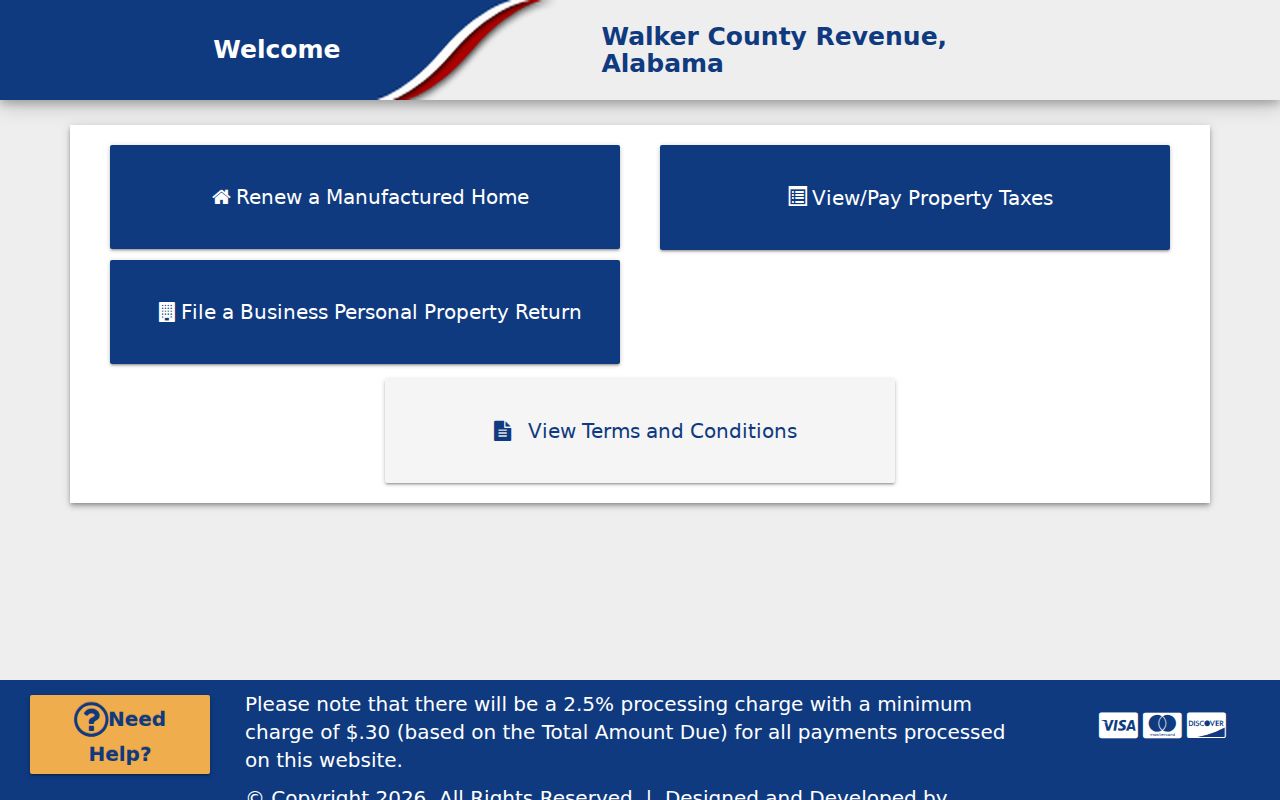
The official portal image shows the authorized entry point and its fee notice, not the contents of any unseen parcel result.
Retrieve a Walker Tax Bill
A sound property tax lookup keeps appraisal and payment evidence together. Start with an address, then save the system identifier for every figure that follows.
- Confirm that the address is assessed in Walker County.
- Search the county-linked portal, or call Revenue if its result will not load.
- Record the PIN or account, tax year, bill, balance, and payment status shown.
- Compare the appraisal entry for class, value, and exemptions.
- Save a receipt or request an official copy when proof of payment matters.
- Assessed value
- Appraised value after the Alabama class ratio is applied.
- Millage
- The rate applied to taxable assessed value; one mill is one-thousandth.
- Homestead exemption
- Relief that may reduce value for a qualifying owner-occupied home.
- Tax lien
- A statutory claim tied to unpaid ad valorem tax, not immediate ownership.
Classes Shape Walker Property Tax
The ALDOR assessment page sets the statewide formula. Class I utilities use 30 percent. Class II property generally uses 20 percent. Agricultural, forest, qualifying residential, and historic Class III property generally uses 10 percent, so confirm the parcel's assigned class rather than judging use from an aerial.
Homestead relief centers on a qualifying primary home and up to 160 acres. Alabama exemptions commonly labeled H-1 through H-4 hinge on age, disability, and income rules. Apply through Walker Revenue. Ask which tax year an approval affects.
Act 2024-344 adds a 7 percent cap for covered Class II and III taxable-assessed-value increases. True assessed value and taxable assessed value are separate. The cap never applies to a sale price or the GIS TL Value field, so review current ALDOR assessment guidance for the full terms.
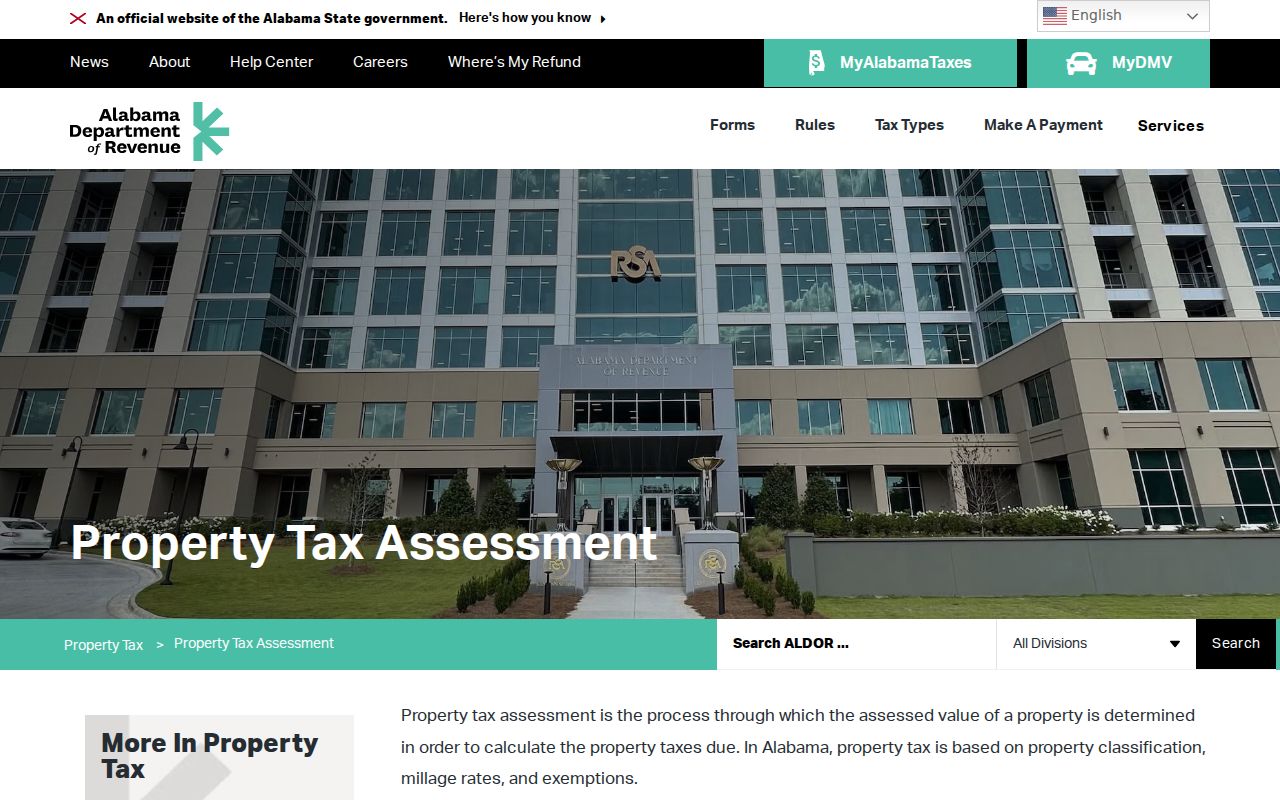
The state page sets terms; Walker Revenue supplies parcel numbers.
Walker Delinquency Has Stages
Walker Revenue says taxes turn delinquent after December 31, with penalties and interest running from January 1. Special payment limits apply after February 15. Get a current payoff, not an estimate.
The county switched to tax-lien auctions in 2020. GovEase registration, auction, payment, and first-rights dates change each cycle, and the current notice points to May 3, 2027 for 2026 taxes. Recheck it first. ALDOR's delinquent-property entry offers weekly-updated transcripts that may omit a physical address.
A lien is not a deed. A balance, auction listing, lien certificate, redemption, and later tax deed are distinct records. Confirm the parcel, legal description, status, and redemption with Revenue.
Contest a Walker Assessment
An owner may send a written protest to the Walker County Board of Equalization. Strong evidence includes the valuation notice, PIN, tax year, correct physical facts, dated photos, a qualified appraisal, and well-matched comparable sales. A wrong building fact is not a market dispute. Match the evidence to the claim.
Thirty-day appeal clock. ALDOR says the written protest must reach the Board of Equalization within 30 calendar days after the written valuation notice. Alabama Code §§40-3-20, 40-3-24, and 40-3-25 govern review and later appeal.
Read ALDOR's current value-dispute answer and preserve the notice date.
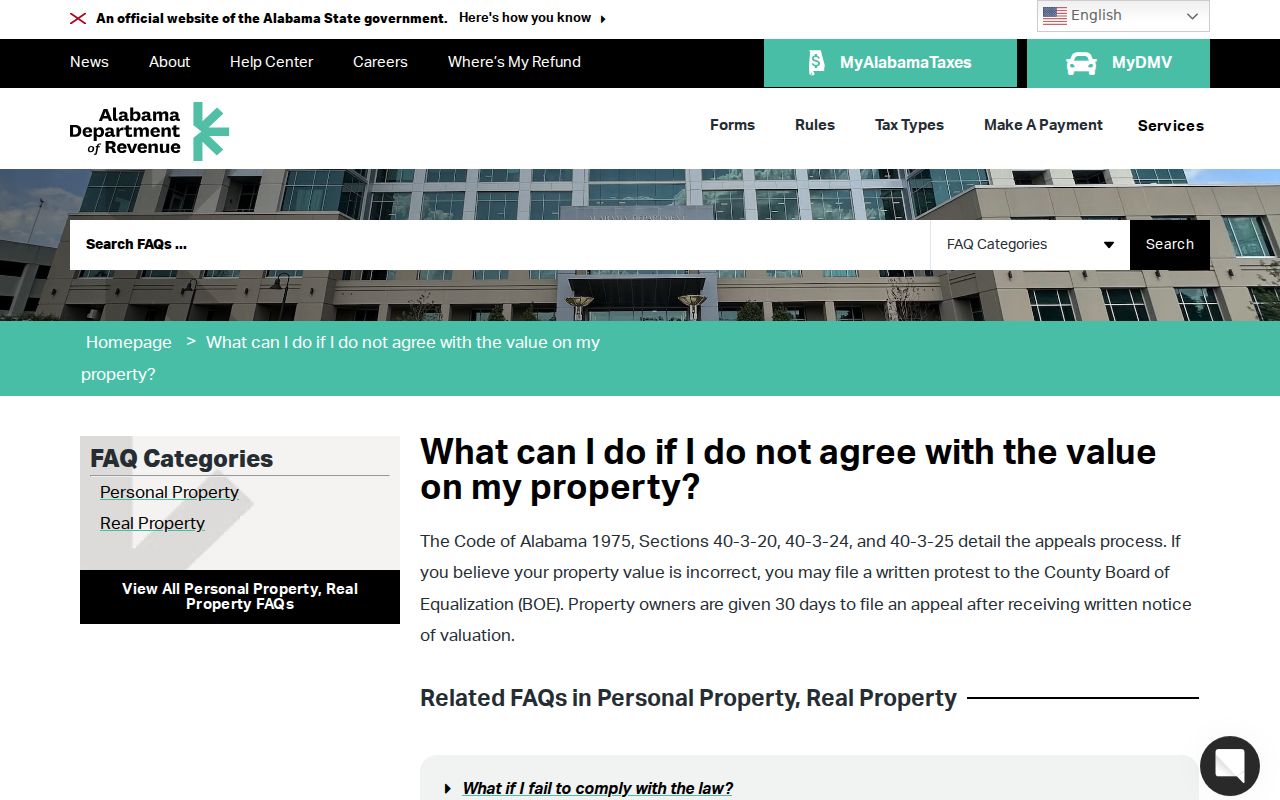
The state page sets the deadline framework. The county notice and local filing record control each parcel's case.
Preserve Walker Tax Proof
Save the URL, access date, account, tax year, and status shown. A portal screenshot documents a session. But a county receipt or official copy is stronger for a closing, redemption, or dispute. Alabama Code §36-12-40 supports access to public writings subject to exceptions. No universal response deadline or fee applies to every office.
Tax records do not settle title or boundaries. Turn to Walker deed records for ownership instruments. Walker parcel maps add location context. Walker home value records let you compare appraisal, assessment, and deed consideration.
Compare Walker Tax Years
A year-to-year comparison works best as a table. Give every Walker County tax year its own row. Record the appraised value, class, assessed value, taxable assessed value, exemption code, millage, bill, payment status, and source date. Laying the figures side by side shows where a change really began, whether with appraisal, classification, lost relief, a new tax rate, or an unpaid balance. The bottom-line bill alone hides all of those causes.
Keep corrections separate from routine movement. A later record may differ from the first notice after an exemption approval, a mapping correction, a parcel split, or a Board decision. Ask Revenue which entry is final. Follow both the old and new PINs whenever a parcel split or merged, so payment never attaches to the wrong tract.
Status terms are not interchangeable. Paid, due, delinquent, advertised, lien sold, redeemed, and tax deed issued mark different stages of the same parcel account. Write down the date and the office supplying each term, then verify the current status directly before any purchase or estate matter.
Walker Tax Liens Follow a Calendar
Walker Revenue runs an annual tax-lien auction rather than posting a standing list of properties for sale. The county moved to lien auctions for the 2020 collection year. Auction mechanics shift by cycle. Registration periods, bidding windows, bidder payment terms, owner notices, and any first-right procedure come from the current Revenue notices and the GovEase auction rules. Certificates go to winning bidders, not to walk-in buyers.
A tax-lien certificate is not the parcel's tax bill. Neither one is a conventional foreclosure deed. Start with the tax account and the delinquent year. Then pull the county process notice and the state delinquent-property transcript where one applies. Label each record for what it shows: delinquency, an auctioned lien, later redemption, or a deed. The parcel number anchors every lookup. Never collapse those events into a single status.
Card payments carry a 2.5 percent service charge with a 30-cent minimum. The amount and terms on the live checkout screen govern, so confirm them there before paying.
For an office request, list the parcel PIN, the assessed owner, the tax year, and the exact status being checked.
Assessment questions also go through Walker Revenue by phone. A visit to the courthouse works too. A written protest to the Board of Equalization must be filed within 30 calendar days of the valuation notice. The Alabama process ALDOR describes sets that deadline. Bring the parcel PIN and the notice. Comparables, photos, repair facts, and similar value evidence all help. Exemption questions should name the tax year and property class. A homestead benefit changes taxable assessed value, not the recorded deed.
Ask Revenue for the retained tax record and payment history by parcel and year. Use it when an online account is older or unavailable. State delinquent-property sources supplement county status, but they do not replace it.